بِسْمِ اللَّهِ الرَّحْمَٰنِ الرَّحِيمِ
Those who delve deeply into the Quran can appreciate its unique way of describing people and events across different passages, often with varying levels of detail. It is a tightly interwoven text, where connections between verses may not always be immediately obvious but are subtly hinted at—through recurring words, themes, or situations.
Frequently, an incident or person mentioned in one place is elaborated on or referenced in other ayahs elsewhere. However, the Quran is not primarily a book about people; it is a book of guidance. The mention of individuals and their stories serves a greater purpose: to offer lessons and insights for reflection and guidance.
111:1-5 تَبَّتْ يَدَا أَبِي لَهَبٍ وَتَبَّ مَا أَغْنَىٰ عَنْهُ مَالُهُ وَمَا كَسَبَ سَيَصْلَىٰ نَارًا ذَاتَ لَهَبٍ وَامْرَأَتُهُ حَمَّالَةَ الْحَطَبِ فِي جِيدِهَا حَبْلٌ مِّن مَّسَدٍ
Ruined are the hands of the Ibi Lahab (Father of the flame) ! And he is ruined (too). His wealth and what he earned didn’t benefit him. Soon he will be cast in a Fire of Blazing Flame! His woman is the carrier of fuel (of fire). A rope of palm-leaf fiber is round her neck.
In Sura Masad (111), Allah mentions a personality with the title of Abu Lahab. Literally, Abu Lahab means ‘father of flame’. It is obvious that such a title would suggest a person who is burning in his own fire. The fire which burns a person internally can be of hatred, ego, anger, jealousy, fear, suspicion or a combination of all. As we mentioned earlier it is highly unlikely that Quran just mentions a random person at one place without giving details in other ayahs. Therefore, we will need to search Quran for subtle hints about its connection at other places in the text of Quran. This sura mentions a couple. We may start our search for couples mentioned in Quran. We would filter out prophets and messengers as obviously the description of the husband is the one destined for fire.
Other than the messengers and prophets, the couples mentioned in Quran are Abu Lahab and his wife (111:1-5), Aziz of Egypt and his wife (12:21), Zaid and his wife (33:37), A woman who complained about her husband (58:1) and Pharaoh and his wife (66:11). We will see if we can find connection of Sura 111 with any of the couples mentioned here.
As the title ‘father of flame’ has strong connotations, the character should be described in detail in Quran so that people can take heed from the characteristic traits. Quran will not leave details of the characteristics to be found and searched in books other than Quran whose authority is not guaranteed by Allah. In order to find details of Abu Lahab, we will check for the occurrence of root word (ت ب ب) used to describe his destruction in Quran (تَبَّ):
40:37 أَسْبَابَ السَّمَاوَاتِ فَأَطَّلِعَ إِلَىٰ إِلَٰهِ مُوسَىٰ وَإِنِّي لَأَظُنُّهُ كَاذِبًا ۚ وَكَذَٰلِكَ زُيِّنَ لِفِرْعَوْنَ سُوءُ عَمَلِهِ وَصُدَّ عَنِ السَّبِيلِ ۚ وَمَا كَيْدُ فِرْعَوْنَ إِلَّا فِي تَبَابٍ
“The means of access to the heavens so that I may take a look towards god of Moosa and for sure, I assume him (Moosa) a liar!”. Thus was made alluring, in Pharaoh’s eyes, the evil of his deeds, and he was hindered from the path; and the plot of Pharaoh led to nothing but perdition (for him).
So the same word (ت ب ب) which describes the destruction of Abu Lahab in 111:1 is used to describe the destruction of Pharaoh. This root word occurs one more time in 11:101 in the form of ‘تَتْبِيبٍ’ and also with the mention of Pharaoh and the likes of him.
The 2nd ayat 111:2, mentions about the wealth of Abu Lahab which did not work to save him from his destruction. For the couples mentioned earlier in this post, Pharaoh is obviously super rich and as per ayat 10:88, he uses his wealth to mislead from Allah’s path, and prophet Moosa (a.s) pleads Allah to destroy him on his wealth.
10:88 وَقَالَ مُوسَىٰ رَبَّنَا إِنَّكَ آتَيْتَ فِرْعَوْنَ وَمَلَأَهُ زِينَةً وَأَمْوَالًا فِي الْحَيَاةِ الدُّنْيَا رَبَّنَا لِيُضِلُّوا عَن سَبِيلِكَ ۖ رَبَّنَا اطْمِسْ عَلَىٰ أَمْوَالِهِمْ وَاشْدُدْ عَلَىٰ قُلُوبِهِمْ فَلَا يُؤْمِنُوا حَتَّىٰ يَرَوُا الْعَذَابَ الْأَلِيمَ
And Moosa said, ‘O, Our Lord! Without doubt, You have given Pharaoh and his chiefs, the adornment and wealth in this world, O our Lord! So that they mislead about your way. O’ our Lord! Obliterate them on their wealth and make them rigid on their hearts, so they will not believe until they see the dreadful punishment.’
The third ayat of sura 111, mentions that Abu Lahab will soon be entered in fire of flames. We see the connection of Pharaoh presented on fire every morning and evening, with the below ayahs:
40:45-46 فَوَقَاهُ اللَّهُ سَيِّئَاتِ مَا مَكَرُوا ۖ وَحَاقَ بِآلِ فِرْعَوْنَ سُوءُ الْعَذَابِ النَّارُ يُعْرَضُونَ عَلَيْهَا غُدُوًّا وَعَشِيًّا ۖ وَيَوْمَ تَقُومُ السَّاعَةُ أَدْخِلُوا آلَ فِرْعَوْنَ أَشَدَّ الْعَذَابِ
Then Allah saved him from (every) ill that they plotted, but the brunt of the penalty encompassed all sides the people of Pharaoh. In front of the Fire will they be brought, morning and evening, and when the Day that Judgment will be established. “Cast ye the People of Pharaoh into the severest of penalty!”
If we try to find connection of Sura Masad with the other couples mentioned earlier, we may see that Aziz of Egypt should also be a fairly well to do person. However, Aziz is not portrayed as a negative person in Quran. He did well for the care of prophet Yousef (a.s) and Quran did not mention any thing negative about him. His wife is portrayed as a negative character though and the intention of infidelity in her, must have caused some heart burn in Aziz. However she seems to repent later and confirmed that she actually did not cheat on him. To earn the title of father of flame, Pharaoh has far more connections in Quran than Aziz. The other couples mentioned in Quran do not have much connection with Sura Masad.
Characteristic traits of Pharaoh:
What characteristic traits of the Pharaoh, are described in Quran, so that people in all era’s recognize and take heed. He is obviously a prime example of arrogance, oppression, and denial of truth. His traits and actions made him an enemy of Allah. Here are the main characteristic traits that defined the Pharaoh:
- Using political power and wealth of the nation to allure people away from God’s path and posing himself, his estate and technology as a granter of well being instead of God.
- Using political power and hate propaganda to render a section of population under his control as subservient and inferior to the other sections of populace, i.e not providing equal rights to all the populace.
- Rejection of God signs not out of ignorance but because of arrogance and vested interests despite being shown undeniable signs repeatedly.
- Repeated disobedience after less severe punishments were relieved for some time giving him chance to mend his ways but he and his likes repeatedly went back to their evil ways right after the temporary relief.
- Ruling with tyranny with no respect for justice system, i.e killing innocent new born boys of a certain populace, out of unfounded fear.
- Promoting the tricksters and fabricators (magicians) who were allowed only to propagate his version of beliefs and mesmerize the populace.
- Not allowing believers who adhere to the Book of Allah, His orders and prophet-hood, to follow God’s path on his land despite prophet Moosa (a.s) repeated calls to relieve them of his imposed restrictions.
- Corruption and waste of national wealth on vanity projects e.g building huge capital and resource intensive pyramids which were not of much use for the nation well being except for his personal gratification.
The wife:
Ayat 4 and 5 of sura Masad, mention the wife of Abu Lahab. An indication of the positive character of the wife of Abu Lahab is with the choice of the word for her neck. While different words can be used in Arabic for the ‘neck’, the word used is ‘جِيد‘ which is used for graceful neck of a woman. The other words like عُنُق, رَقَبَة, can also be used for ‘neck’ which are neutral however جِيد (jeed) – is Poetic, feminine and elegant. The other word used in Quran e.g عُنُق, رَقَبَة, are used in the theme of stress and punishment.
- Meaning: A poetic or literary word often referring to the graceful neck of a woman, sometimes used in romantic or descriptive poetry.
- Usage: Found in classical Arabic poetry or romantic literature.
- Tone: Soft, romantic, aesthetic.
Ayat 4, informs that she is the carrier of the fuel to the fire. It seems the wife has something to do with adding fuel to the fire in which the ‘father of flame’ is burning. The wife, was instrumental in convincing Pharaoh for adopting prophet Moosa (a.s) when he was an infant, who later became a major pain point for the Pharaoh. The wife of Pharaoh was also a believer of Allah while Pharaoh promoted his deification among his people. So having a believer in his house who does not believe in him as deity, but consider him an evil person could be another big source of constant annoyance to Pharaoh.
The last ayah of Sura 111, mentions a palm fiber rope around her neck. Metaphorically this could be describing that despite her hatred for her husband’s evil actions, she was bound by his laws and was sort of captive in his estate. Physically we also find that it was common for the people to wear some fiber woven collars in Egypt in Pharaoh days. Some pictures of ancient artifacts of Egypt are given below:


The sura also mention of destruction of two hands of the ‘father of the flame’. It seems that there was a custom of severing the enemy hands at that time in Egypt as depicted in some ancient art forms of that time. It could be that the same connotation is used for Pharaoh’s destruction.
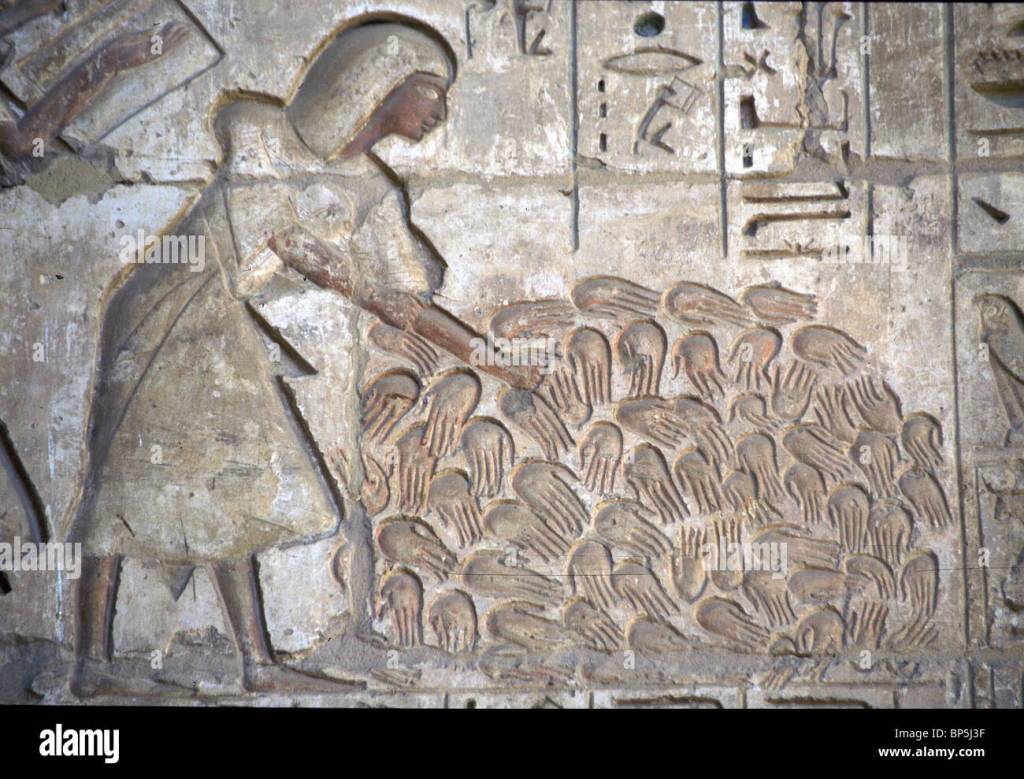
Another possible connection with the mention of Pharoah’s two hands could be his two main partners or right hands, i.e ‘Haman’ and ‘Qarun’. Qurun’s destruction is specifically mentioned separately and Haman would have been doomed with the rest of Pharaoh’s chiefs and people. Thus destruction of the Pharoah, Qarun and Haman was the culmination of the prayer of prophet Moosa in ayat 10:88 and described summarily in Sura Masad.
Traditional rendering and Exegesis:
The history books related Abu Lahab to be an individual named Abd al-ʿUzzā ibn ʿAbd al-Muṭṭalib (Arabic: عبد العزى ابن عبد المطلب), better known as Abū Lahab (Arabic: أبو لهب, lit. ‘Father of the Flame’;[a] c. 549–624 CE) was the prophet Mohammad’s half paternal uncle.
The Hadith books which have some criteria of certification have very limited mention of him obviously in an attempt to explain sura 111.
- Hadith Collections:
- The Kutub al-Sitta (Six Major Hadith Collections) contain limited references to Abu Lahab. A notable narration in Jami` at-Tirmidhi describes an incident where Prophet Muhammad called the Quraysh to Mount Safa to warn them, prompting Abu Lahab to respond dismissively. This event is linked to the revelation of Surah Al-Masad (Qur’an 111).
The actual texts of the few Hadiths which mention Abu Lahab are given below:
Jami` at-Tirmidhi 3363 – Chapters on Tafsir
Narrated by Ibn ‘Abbas:
“One day the Messenger of Allah ascended As-Safa and called out: ‘O people! Come at once!’ So the Quraysh gathered before him. He said: ‘I am a warner for you before the coming of a severe punishment. Do you think that if I informed you that the enemy was preparing to attack you in the evening or in the morning, would you believe me?’ They replied: ‘Yes.’ He said: ‘Then I am a warner to you before the coming of a severe punishment.’ So Abu Lahab said: ‘Is it for this that you gathered us? May you perish!’ So Allah, Blessed is He and Most High, revealed: ‘Perish the hands of Abu Lahab, perish he.'”
— Jami` at-Tirmidhi 3363
📖 Sahih al-Bukhari – Volume 2, Book 23, Hadith 477
Narrated by Ibn ‘Abbas:
“When the verse ‘Perish the hands of Abu Lahab’ was revealed, the Prophet said: ‘Abu Lahab said: May you perish all day.'”
— Sahih al-Bukhari 2:23:477
Sahih al-Bukhari, Volume 2, Book 23, Hadith 477
Narrated Ibn Abbas:
Abu Lahab, may Allah curse him, once said to the Prophet (ﷺ), “Perish you all the day.” Then the Divine Inspiration came: “Perish the hands of Abi Lahab! And perish he!” (Surah Al-Masad 111:1).
Most other details about this individual Abd al-ʿUzzā, come from Ibn Ishaq book and Tafsir literature which are without certification. While they offer comprehensive narratives, they were compiled generations after the events and often rely on oral traditions. Therefore, while informative, they may contain embellishments or inconsistencies.
- Early Biographies (Sīrah):
- Ibn Ishaq’s “Sirat Rasul Allah” (as edited by Ibn Hisham) and Ibn Sa’d’s “Tabaqat al-Kubra” offer detailed accounts of Abu Lahab’s life. These works describe his actions against Prophet Muhammad, including encouraging his sons to divorce the Prophet’s daughters and supporting the Quraysh’s boycott of the Banu Hashim clan. Wikipedia+1Wikipedia+1
- Tafsir Literature:
- Exegetical works, such as those by Ibn Kathir, provide context to Qur’anic verses mentioning Abu Lahab, elaborating on his opposition to Islam and his eventual demise.
📖 🧕 Arwā bint Harb (also known as Umm Jamil) wife of Abu Lahab of history
- She was the sister of Abu Sufyan, a powerful leader of the Quraysh tribe.
- Her kunya (title) Umm Jamil means “Mother of Beauty,”
Abu Lahab’s wife, Umm Jamil (Arwā bint Harb), is mentioned in Islamic literature, particularly in exegeses (tafsir) and early biographies (sīrah), though not prominently in the primary Hadith collections like Sahih al-Bukhari or Sahih Muslim.
But in sīrah and tafsir sources, he’s portrayed with rich behavioral detail: pushing thorns, slandering, urging his sons to divorce the Prophet’s daughters, etc.
 Topics from The Book (Al-Kitab)